Done correctly, warming up and cooling down may offer help in reducing your risk of injury and improving your athletic performance.
You're ready to hit the elliptical machine or the running trails. Before you do, though, consider doing a brief warm-up, followed by a quick cool-down session when you're done exercising. Sure, a warm-up and cool-down may add a few minutes to your exercise routine, but they also might help you stay healthier.
Why warm up and cool down
There's some controversy about whether warming up and cooling down offer health benefits. But proper warm-ups and cool-downs pose little risk, so if you have the time, consider adding them to your workout schedule. Warm-ups and cool-downs generally involve doing your activity at a slower pace and reduced intensity.
Warming up may help prepare your body for aerobic activity. Warming up gradually revs up your cardiovascular system, increases blood flow to your muscles and raises your body temperature. Jumping into an aerobic workout without preparing your body could lead to such problems as muscle strain or injury.
Cooling down after your workout may help gradually reduce the temperature of your muscles, especially if you've had an intense workout. Cooling down may help reduce muscle injury, stiffness and soreness, but the research is uncertain.
How to warm up
Warm up right before you plan to start your workout. In general, warm up by focusing first on large muscle groups, such as your hamstrings. Then you can do exercises more specific to your sport or activity, if necessary. A warm-up may cause mild sweating, but it shouldn't leave you fatigued.
Here are some examples of warm-up activities:
To warm up for a brisk walk, walk slowly for five to 10 minutes.
To warm up for a run, walk briskly for five to 10 minutes.
To warm up for strength training, move your muscles and joints through the movement patterns you'll do during the exercise, but before you start with weights.
To warm up for soccer, do slow, soccer-specific running drills.
To warm up for swimming, swim slowly at first and then pick up the tempo as you're able to.
Aerobic exercise: How to warm up and cool down
How to cool down
Cooling down is similar to warming up. You generally continue your workout session, but at a slower pace and reduced intensity. Cooling down may be most important to the best athletes, such as well-conditioned marathoners. For them, cooling down is important because it helps regulate blood flow. For others, cooling down may simply become an enjoyable ritual as part of an overall exercise program.
Here are some examples of cool-down activities:
To cool down after a brisk walk, walk slowly for five to 10 minutes.
To cool down after a run, walk briskly for five to 10 minutes.
To cool down after biking, spin on your bicycle at higher revolutions per minute (around 100) as you finish your exercise.
To cool down after swimming, swim some leisure laps for five to 10 minutes, varying your strokes.
A word about stretching
Consider adding stretching to your cool-down session. Stretching can increase blood flow to your muscles. Stretching may also help improve your performance in some activities or decrease your risk of injury by allowing your joints to move through their full range of motion.
If you have a tight or previously injured muscle, stretch the affected muscle after you warm up. Hold each stretch for about 30 seconds. And remember to keep it gentle. Don't bounce. Don't stretch to the point of pain. Sudden or aggressive stretching motions may actually cause an injury or worsen and injury.
Be kind to your body
Finding time for regular aerobic workouts — plus warming up and cooling down — can be challenging. But if you're tempted to skip warming up and cooling down, get creative. If you walk to a fitness facility, use the trip there and back to warm up and cool down. Remember, be kind and give your body time to adjust to the demands of your workout.
Tuesday, August 16, 2011

What aerobic exercise does for your health
Aerobic exercise: Top 10 reasons to get physical
What aerobic exercise does for your healthRegardless of age, weight or athletic ability, aerobic activity is good for you. As your body adapts to regular aerobic exercise, you'll get stronger and fitter. Consider the following 10 ways that aerobic activity can help you feel better and enjoy life to the fullest.
Aerobic activity can help you:
- Keep excess pounds at bay
Combined with a healthy diet, aerobic exercise helps you lose weight — and keep it off. - Increase your stamina
Aerobic exercise may make you tired in the short term. But over the long term, you'll enjoy increased stamina and reduced fatigue. - Ward off viral illnesses
Aerobic exercise activates your immune system. This leaves you less susceptible to minor viral illnesses, such as colds and flu. - Reduce your health risks
Aerobic exercise reduces the risk of many conditions, including obesity, heart disease, high blood pressure, type 2 diabetes, stroke and certain types of cancer. Weight-bearing aerobic exercises, such as walking, reduce the risk of osteoporosis. - Manage chronic conditions
Aerobic exercise helps lower high blood pressure and control blood sugar. If you've had a heart attack, aerobic exercise helps prevent subsequent attacks. - Strengthen your heart
A stronger heart doesn't need to beat as fast. A stronger heart also pumps blood more efficiently, which improves blood flow to all parts of your body. - Keep your arteries clear
Aerobic exercise boosts your high-density lipoprotein (HDL or "good") cholesterol and lowers your low-density lipoprotein (LDL or "bad") cholesterol. The potential result? Less buildup of plaques in your arteries. - Boost your mood
Aerobic exercise can ease the gloominess of depression, reduce the tension associated with anxiety and promote relaxation. - Stay active and independent as you age
Aerobic exercise keeps your muscles strong, which can help you maintain mobility as you get older. Aerobic exercise also keeps your mind sharp. At least 30 minutes of aerobic exercise three days a week seems to reduce cognitive decline in older adults. - Live longer
Studies show that people who participate in regular aerobic exercise live longer than those who don't exercise regularly.
10 top camping advises
1. Finding a campground
Not every campground is right for every camper. Choose accordingly. If you're new to camping, pick a public campground close to home. Public campgrounds are run by a government agency, and they are consistent in their services and regulations. Private campgrounds vary from one to another. If you are tent camping, avoid RV parks. Believe me, most tent campers don't like camping next to RVs, which can be noisy with their A/C and generators running all night.
S
2. Reservations
Don't make reservations at a campground that you have never visited. Reservations get lost, campgrounds fill up, and you may travel long distances only to find out that you have no campsite. If you must make reservations, be sure to get a confirmation over the phone or in an email, and get all necessary information while on the phone. Ask about their cancellation and refund policy, check-in times, and visitor rules before you get to the campground.
3. Try out gear in advance
When you acquire new camping gear, take the time to try it out before you get to the campground. Set the tent up in your back yard so that you can become familiar with how it goes up, and just as import, how it comes down and packs. Use your sleeping bags in the family room for a night to see how comfortable it is and how well you sleep. Cook a meal on your stove to see how well it performs. Try your lanterns outside at night so that you can see just how much light they give off.
4. Choosing a campsite
They say when buying real estate that it's all about location. You could say the same thing about choosing a campsite. When choosing a campsite, look at its proximity to things like bathrooms, showers, playgrounds, dog loops, lakes/rivers, and garbage disposal areas. Some places are nice to have nearby while others, depending on your personal preferences, are better off further away. Never choose your campsite hastily.
5. Tent placement
As a general rule, pick a high level spot to pitch your tent. You'll sleep better, and should it rain during the night water will drain away from your tent. Erect your tent far enough from any grill or campfire so that sparks won't fly into it. Never set your tent up on low ground. Aim your tent door away from the direction of the morning sun. That way you won't wake up and exit your tent into the blinding sun.
6. Food cooking/eating/storage
Cook food outdoors in designated areas, usually around the grill or campfire. Never cook in your tent. A small flame or spark can quickly put holes in a tent. Eat wherever you like at your campsite, but never eat in your tent. Critters will not hesitate to eat holes in your tent to get to food crumbs. Store all food in tight containers, preferably in the trunk of your car. If you leave your cooler out, put a rock or something heavy on top to keep critters out. Never leave food sitting out.
7. Foul weather
Heavy rain, lightning, snow storms, and high winds all spell misfortune to the camper. Unless you are a die-hard camper that camps in any weather, avoid camping when storms are brewing. If the weather forecast looks bad, consider rescheduling your camping trip. If you are intent on camping when it is possible that it might rain, you better have a tent that will keep you dry. There's nothing more uncomfortable than being soaking wet inside your tent.
8. Safe campfires
One of the joys of camping is sitting around the campfire. Wherever you build your campfire, keep it small. A bonfire is not necessary. Keep a bucket of water nearby, and use it to douse the fire before retiring. If you have kids, closely supervise them, and remember that toasted hotdogs and marshmallows can be very hot. Never leave a campfire unattended. Be sure you have bandages and burn ointment in your first aid kit. Ice works well to sooth the pain of burns too.
S
9. Bugs and critters
You are camping outdoors where birds, bugs and other critters live. Watch wildlife from a safe distance. Take sprays to deter bugs. When camping in the woods, check now and then for ticks. Don't leave food out unattended, and don't feed the wildlife, they will continue to come around your campsite and be a nuisance.
10. Packing up
When it is time to leave the campground, try to pack your gear dry. If you must pack it wet, be sure to spread it out to dry at home at your first opportunity to avoid mold and mildew. Pick up all trash and debris around your campsite, and dispose of it properly. As a courtesy to campers just arriving, tell the campground attendant when you are leaving that your site is available.
Saturday, August 13, 2011
10 Best Places to Live And Boat
Somewhere the grass is always greener and the water always bluer. The question: Don't such thoughts have more to do with fantasy than reality? Maybe not. We investigated boating communities throughout the country, looking for the variety of boating opportunities, boat-friendly regulations, water access, availability of waterfront homes, health of the local economy and overall lifestyle for boaters. The following 10 locations are where boaters might find that imagination meets reality.
Seattle, Washington
Geographically, Seattle is flat-out ideal for boating and the outdoor lifestyle. You hear about the gray weather, but those who live here do not let that (whether fact or somewhat exaggerated fact) dampen their zeal.
"We have hundreds of miles of protected salt water from the San Juans in the north to Olympia in the south," says Make Shultz of the Port of Seattle. All of it is surrounded by the scenic beauty of the Olympic and Cascade Mountains, forested islands and peninsulas, as well as the urban scenery and amenities of Seattle.
Not surprisingly then, life in Seattle seems to closely revolve around the outdoors, and the water in particular. Boating communities like Lake Union and Lake Washington are really the lifeblood of Seattle, as evidenced by all the Microsoft and Boeing employees who commute to work from their homes on the waterfront.
Scorecard (scale of 1-5)
Waterfront Availability: 4
Ease for Boaters: 5
Strong Boat-Related Business: 5
Number of Good Boating Days: 3
<!--pagebreak-->
Benton County, Arkansas
Ten years ago, Benton County was a little boating secret in the Ozark Mountains. The secret's out. Benton is the third-fastest- growing county in the United States, due in large part to the clean environment, improving economy and accessibility of 30,000 acres of boatable water.
"We're known for our smooth clear lakes around here," says Kevin Callahan, owner of Horseshoe Bend Marina on Beaver Lake. "There's always a bunch of recreational boating going on, and a little diving too."
Beaver Lake, which stretches 90 miles, is the most popular spot for boaters, and residential development has exploded there. Eagle's Bluff, for example, has recently acquired 2,355 lakefront acres on which to build houses. To top it off, the boating season is pretty much year-round, dipping only when a "blue norther" rolls in.
Scorecard (scale of 1-5)
Waterfront Availability: 5
Ease for Boaters: 5
Strong Boat-Related Business: 3
Number of Good Boating Days: 4
<!--pagebreak-->
Tampa Bay, Florida
The amount of sun on Tampa Bay alone would make it a contender for the best places to live and boat. St. Petersburg straddles the Gulf of Mexico and Tampa Bay and averages 361 days of sunshine per year. Then there's the bay, which has more than 100 tributaries refreshing it. With that much waterfront land to work with, it's no wonder there's been such an explosion of home sites during the past two years; MiraBay and Little Harbor alone will total nearly 3,000 homes with water access when completed.
Tampa and St. Pete have long had a reputation for good fishing and sightseeing by boat because the entire area is connected by, and to, the water. "We even have these short-term slips near downtown, kind of like parking meters," says Walt Miller, marina and pier manager at St. Petersburg Marina. "You can pay a dollar an hour to dock your boat and go to a restaurant or go shopping."
Scorecard (scale of 1-5)
Waterfront Availability: 5
Ease for Boaters: 5
Strong Boat-Related Business: 5
Number of Good Boating Days: 5
<!--pagebreak-->
Knoxville, Tennessee
It's not hard to figure out why boat manufacturers such as Sea Ray, Bayliner, MasterCraft and Skier's Choice, among others, set up shop in or near Knoxville. The Tennessee River, which runs right through downtown, is part of every aspect of life here. Upstream of the city, the river is a popular fishing and camping spot. Closer to the city, recreation is ever feeding from the river.
"The biggest pull for the downtown area is the [University of Tennessee] football season because of the massive tailgating parties on boats," says Joe Cornelius, manager of the Marinas on Lake Loudon.
As the river flows out of downtown, it forms Fort Loudon Lake where there's been a recent boom of lakefront housing development. But the centerpiece of the area is Tellico Lake, where most of the boatbuilders test their boats. It also became the place to live ever since nationally known Tellico Village opened in the 1990s.
Scorecard (scale of 1-5)
Waterfront Availability: 4
Ease for Boaters: 5
Strong Boat-Related Business: 5
Number of Good Boating Days: 4
<!--pagebreak-->
Fort Lauderdale, Florida
Popularly called the "Venice of America," Fort Lauderdale has the Venetian feel of a floating city. Its 165 miles of canals and waterways weave all around and through the city. And combined with Florida's year-round boating weather, that means boaters of all types can easily spend entire days without setting foot on land.
"We even have our own bus system on the water," says Mike Driver, dockmaster of Lauderdale Marina. "It started out as a water taxi service using 26-foot boats. Now they can carry up to 46 people around the canals."
The water is such a vital part of the Fort Lauderdale area that it's no surprise that marina and boat-related business is a driving force in the city, topping $5 billion annually. Perhaps fittingly, the world's largest in-water boat show takes place here every October.
Scorecard (scale of 1-5)
Waterfront Availability: 5
Ease for Boaters: 4
Strong Boat-Related Business: 5
Number of Good Boating Days: 5
<!--pagebreak-->
Otter Tail County, Minnesota
Minnesota is dubbed the "Land of 10,000 Lakes," and the state owes a lot of that number to Otter Tail County. The county officially contains 1,048 lakes, the most contained in a single county in the United States.
"People love to live on lakes up here," says Bill Kalar of the Otter Tail County Land and Resource Management Department. "Every year we have more waterfront homes being built. We've got no shortage."
What the area loses to a short summer, it more than makes up for with some of the most passionate boaters in the country. You'd be hard-pressed to find a single person in the county who doesn't spend at least one day on the water. The construction of an ethanol plant in the area promises new jobs and more than $110 million per year added to the local economy, making the near future look bright.
Scorecard (scale of 1-5)
Waterfront Availability: 5
Ease for Boaters: 4
Strong Boat-Related Business: 3
Number of Good Boating Days: 2
<!--pagebreak-->
Finger Lakes, New York
Summer revolves around the water, as does the tone of the community. There are trout derbies on Seneca Lake, day cruises on the winding Canandaigua Lake and picnics at anchor on Cayuga Lake.
All 11 lakes are open enough to be called naturally serene. Finger Lakes wine is regarded as among the best in the United States outside of California, and the region is generally in an economic upsurge. That's why there's a lot of lakefront property being developed in the area.
"There's controversy up here on how much is wise to build," says Pat Charland, vice president of marketing at the Finger Lakes Visitor's Connection. "It's sort of a delicate balance."
How do you keep the ambience while reaching out to new boating neighbors? It's a good problem to have in any area where boaters want to live.
Scorecard (scale of 1-5)
Waterfront Availability: 4
Ease for Boaters: 4
Strong Boat-Related Business: 3
Number of Good Boating Days: 2
<!--pagebreak-->
Austin, Texas
Starting in Austin and stretching 85 miles northwest of the city, the Highland Lakes region of Texas is a string of six lakes known for boating and fishing, and as a popular retirement area. But it's also a magnet for younger people because of the healthy economy (which is not dependent on just one industry) and the outdoor lifestyle. By far the most popular of the waterways are the two lakes closest to the city of Austin: Lake Austin and Lake Travis. Each has its distinct advantages.
"The environments are very different," says Marla Schwartz, assistant manager of Lake Austin Marina. "Lake Austin is a lot more focused on skiing and wakeboarding. Lake Travis has more big boats."
To put the general atmosphere in perspective, there are more than a dozen marinas on Lake Travis. And in an effort to keep up with the growing demand, lakefront communities - Lakeway, Briarcliff, Lago Vista and many others - have sprouted up on the water.
Scorecard (scale of 1-5)
Waterfront Availability: 5
Ease for Boaters: 4
Strong Boat-Related Business: 4
Number of Good Boating Days: 4
<!--pagebreak-->
Oconee County, South Carolina
Located less than 20 miles from Clemson University, Lake Keowee and neighboring Lake Jocassee are surprisingly quiet. While the college students stick to Lake Hartwell, Keowee and Jocassee draw a more adult, if not affluent, crowd.
The region sits at the edge of the Appalachian Mountains, and has become a bull's-eye for boaters wanting to relocate from up north or from down south.
About three-quarters of the houses on Lake Keowee are summer homes, but developments like the Cliffs, which has opened three gated mountain-lake residential communities here, are trying to make the lake a more permanent home for many. "The developers are trying to make it into another Lake Lanier [Georgia]," says Nate Ellison, general manager of Lake Keowee Marina. For the time being, the minimal crowd makes it a natural for the top 10.
Scorecard (scale of 1-5)
Waterfront Availability: 5
Ease for Boaters: 4
Strong Boat-Related Business: 3
Number of Good Boating Days: 4
<!--pagebreak-->
San Diego, California
It might be cliché, but when most people think of San Diego, they envision a place where it's 75 degrees every day and the sun is always shining. With the exception of what locals call the June Gloom, that's a pretty accurate assessment. A boater in San Diego seldom has to plan an outing around the weather forecast.
It's common to find boaters relaxing in Mission Bay, having floating cookouts. Many cruise out to Catalina Island for an afternoon bike ride or an overnight getaway. You can even catch a concert at the downtown San Diego amphitheater.
"To look off to your stern and see Coronado Island, then off to your bow and see the beautiful skyline of San Diego while you're listening to a jazz concert is a very unique opportunity," says Kevin Dammeyer of Marine Max in San Diego. Boaters are treated very well because they're so important to the local economy. The only downside is that it might be a little tricky to find a home directly on the water. Popularity comes with a price.
Scorecard (scale of 1-5)
Waterfront Availability: 3
Ease for Boaters: 5
Strong Boat-Related Business: 5
Number of Good Boating Days: 5
<!--pagebreak-->
3 Ways to Increase the Value of Your Waterfront Home
If you own a waterfront home, you're already sitting on a great investment. But we asked Tampa realtor Daniel Westbrook, who deals extensively with waterfront property, to name three improvements that would have the biggest impact on value.
1. Expand Your Dock - With the price of waterfront property increasing so rapidly already, buyers now have more money and probably bigger boats. "Buyers looking for property might have a 30-, 40- or 50-foot boat. Make your dock ready."
2. Add a Deck - People who buy waterfront property want to spend time on the water (in a boat) and next to the water (on a deck). Adding a sun deck onto your dock creates more space to hang out and enjoy what most people can't.
3. Carve a Backyard Path - Laying a path leading to your dock, adding lights and installing trees or other landscape features creates a more pleasing, organized flow from the house to the water. It also helps night visibility, so you and your friends can stay outside longer.
Seattle, Washington
Geographically, Seattle is flat-out ideal for boating and the outdoor lifestyle. You hear about the gray weather, but those who live here do not let that (whether fact or somewhat exaggerated fact) dampen their zeal.
"We have hundreds of miles of protected salt water from the San Juans in the north to Olympia in the south," says Make Shultz of the Port of Seattle. All of it is surrounded by the scenic beauty of the Olympic and Cascade Mountains, forested islands and peninsulas, as well as the urban scenery and amenities of Seattle.
Not surprisingly then, life in Seattle seems to closely revolve around the outdoors, and the water in particular. Boating communities like Lake Union and Lake Washington are really the lifeblood of Seattle, as evidenced by all the Microsoft and Boeing employees who commute to work from their homes on the waterfront.
Scorecard (scale of 1-5)
Waterfront Availability: 4
Ease for Boaters: 5
Strong Boat-Related Business: 5
Number of Good Boating Days: 3
<!--pagebreak-->
Benton County, Arkansas
Ten years ago, Benton County was a little boating secret in the Ozark Mountains. The secret's out. Benton is the third-fastest- growing county in the United States, due in large part to the clean environment, improving economy and accessibility of 30,000 acres of boatable water.
"We're known for our smooth clear lakes around here," says Kevin Callahan, owner of Horseshoe Bend Marina on Beaver Lake. "There's always a bunch of recreational boating going on, and a little diving too."
Beaver Lake, which stretches 90 miles, is the most popular spot for boaters, and residential development has exploded there. Eagle's Bluff, for example, has recently acquired 2,355 lakefront acres on which to build houses. To top it off, the boating season is pretty much year-round, dipping only when a "blue norther" rolls in.
Scorecard (scale of 1-5)
Waterfront Availability: 5
Ease for Boaters: 5
Strong Boat-Related Business: 3
Number of Good Boating Days: 4
<!--pagebreak-->
Tampa Bay, Florida
The amount of sun on Tampa Bay alone would make it a contender for the best places to live and boat. St. Petersburg straddles the Gulf of Mexico and Tampa Bay and averages 361 days of sunshine per year. Then there's the bay, which has more than 100 tributaries refreshing it. With that much waterfront land to work with, it's no wonder there's been such an explosion of home sites during the past two years; MiraBay and Little Harbor alone will total nearly 3,000 homes with water access when completed.
Tampa and St. Pete have long had a reputation for good fishing and sightseeing by boat because the entire area is connected by, and to, the water. "We even have these short-term slips near downtown, kind of like parking meters," says Walt Miller, marina and pier manager at St. Petersburg Marina. "You can pay a dollar an hour to dock your boat and go to a restaurant or go shopping."
Scorecard (scale of 1-5)
Waterfront Availability: 5
Ease for Boaters: 5
Strong Boat-Related Business: 5
Number of Good Boating Days: 5
<!--pagebreak-->
Knoxville, Tennessee
It's not hard to figure out why boat manufacturers such as Sea Ray, Bayliner, MasterCraft and Skier's Choice, among others, set up shop in or near Knoxville. The Tennessee River, which runs right through downtown, is part of every aspect of life here. Upstream of the city, the river is a popular fishing and camping spot. Closer to the city, recreation is ever feeding from the river.
"The biggest pull for the downtown area is the [University of Tennessee] football season because of the massive tailgating parties on boats," says Joe Cornelius, manager of the Marinas on Lake Loudon.
As the river flows out of downtown, it forms Fort Loudon Lake where there's been a recent boom of lakefront housing development. But the centerpiece of the area is Tellico Lake, where most of the boatbuilders test their boats. It also became the place to live ever since nationally known Tellico Village opened in the 1990s.
Scorecard (scale of 1-5)
Waterfront Availability: 4
Ease for Boaters: 5
Strong Boat-Related Business: 5
Number of Good Boating Days: 4
<!--pagebreak-->
Fort Lauderdale, Florida
Popularly called the "Venice of America," Fort Lauderdale has the Venetian feel of a floating city. Its 165 miles of canals and waterways weave all around and through the city. And combined with Florida's year-round boating weather, that means boaters of all types can easily spend entire days without setting foot on land.
"We even have our own bus system on the water," says Mike Driver, dockmaster of Lauderdale Marina. "It started out as a water taxi service using 26-foot boats. Now they can carry up to 46 people around the canals."
The water is such a vital part of the Fort Lauderdale area that it's no surprise that marina and boat-related business is a driving force in the city, topping $5 billion annually. Perhaps fittingly, the world's largest in-water boat show takes place here every October.
Scorecard (scale of 1-5)
Waterfront Availability: 5
Ease for Boaters: 4
Strong Boat-Related Business: 5
Number of Good Boating Days: 5
<!--pagebreak-->
Otter Tail County, Minnesota
Minnesota is dubbed the "Land of 10,000 Lakes," and the state owes a lot of that number to Otter Tail County. The county officially contains 1,048 lakes, the most contained in a single county in the United States.
"People love to live on lakes up here," says Bill Kalar of the Otter Tail County Land and Resource Management Department. "Every year we have more waterfront homes being built. We've got no shortage."
What the area loses to a short summer, it more than makes up for with some of the most passionate boaters in the country. You'd be hard-pressed to find a single person in the county who doesn't spend at least one day on the water. The construction of an ethanol plant in the area promises new jobs and more than $110 million per year added to the local economy, making the near future look bright.
Scorecard (scale of 1-5)
Waterfront Availability: 5
Ease for Boaters: 4
Strong Boat-Related Business: 3
Number of Good Boating Days: 2
<!--pagebreak-->
Finger Lakes, New York
Summer revolves around the water, as does the tone of the community. There are trout derbies on Seneca Lake, day cruises on the winding Canandaigua Lake and picnics at anchor on Cayuga Lake.
All 11 lakes are open enough to be called naturally serene. Finger Lakes wine is regarded as among the best in the United States outside of California, and the region is generally in an economic upsurge. That's why there's a lot of lakefront property being developed in the area.
"There's controversy up here on how much is wise to build," says Pat Charland, vice president of marketing at the Finger Lakes Visitor's Connection. "It's sort of a delicate balance."
How do you keep the ambience while reaching out to new boating neighbors? It's a good problem to have in any area where boaters want to live.
Scorecard (scale of 1-5)
Waterfront Availability: 4
Ease for Boaters: 4
Strong Boat-Related Business: 3
Number of Good Boating Days: 2
<!--pagebreak-->
Austin, Texas
Starting in Austin and stretching 85 miles northwest of the city, the Highland Lakes region of Texas is a string of six lakes known for boating and fishing, and as a popular retirement area. But it's also a magnet for younger people because of the healthy economy (which is not dependent on just one industry) and the outdoor lifestyle. By far the most popular of the waterways are the two lakes closest to the city of Austin: Lake Austin and Lake Travis. Each has its distinct advantages.
"The environments are very different," says Marla Schwartz, assistant manager of Lake Austin Marina. "Lake Austin is a lot more focused on skiing and wakeboarding. Lake Travis has more big boats."
To put the general atmosphere in perspective, there are more than a dozen marinas on Lake Travis. And in an effort to keep up with the growing demand, lakefront communities - Lakeway, Briarcliff, Lago Vista and many others - have sprouted up on the water.
Scorecard (scale of 1-5)
Waterfront Availability: 5
Ease for Boaters: 4
Strong Boat-Related Business: 4
Number of Good Boating Days: 4
<!--pagebreak-->
Oconee County, South Carolina
Located less than 20 miles from Clemson University, Lake Keowee and neighboring Lake Jocassee are surprisingly quiet. While the college students stick to Lake Hartwell, Keowee and Jocassee draw a more adult, if not affluent, crowd.
The region sits at the edge of the Appalachian Mountains, and has become a bull's-eye for boaters wanting to relocate from up north or from down south.
About three-quarters of the houses on Lake Keowee are summer homes, but developments like the Cliffs, which has opened three gated mountain-lake residential communities here, are trying to make the lake a more permanent home for many. "The developers are trying to make it into another Lake Lanier [Georgia]," says Nate Ellison, general manager of Lake Keowee Marina. For the time being, the minimal crowd makes it a natural for the top 10.
Scorecard (scale of 1-5)
Waterfront Availability: 5
Ease for Boaters: 4
Strong Boat-Related Business: 3
Number of Good Boating Days: 4
<!--pagebreak-->
San Diego, California
It might be cliché, but when most people think of San Diego, they envision a place where it's 75 degrees every day and the sun is always shining. With the exception of what locals call the June Gloom, that's a pretty accurate assessment. A boater in San Diego seldom has to plan an outing around the weather forecast.
It's common to find boaters relaxing in Mission Bay, having floating cookouts. Many cruise out to Catalina Island for an afternoon bike ride or an overnight getaway. You can even catch a concert at the downtown San Diego amphitheater.
"To look off to your stern and see Coronado Island, then off to your bow and see the beautiful skyline of San Diego while you're listening to a jazz concert is a very unique opportunity," says Kevin Dammeyer of Marine Max in San Diego. Boaters are treated very well because they're so important to the local economy. The only downside is that it might be a little tricky to find a home directly on the water. Popularity comes with a price.
Scorecard (scale of 1-5)
Waterfront Availability: 3
Ease for Boaters: 5
Strong Boat-Related Business: 5
Number of Good Boating Days: 5
<!--pagebreak-->
3 Ways to Increase the Value of Your Waterfront Home
If you own a waterfront home, you're already sitting on a great investment. But we asked Tampa realtor Daniel Westbrook, who deals extensively with waterfront property, to name three improvements that would have the biggest impact on value.
1. Expand Your Dock - With the price of waterfront property increasing so rapidly already, buyers now have more money and probably bigger boats. "Buyers looking for property might have a 30-, 40- or 50-foot boat. Make your dock ready."
2. Add a Deck - People who buy waterfront property want to spend time on the water (in a boat) and next to the water (on a deck). Adding a sun deck onto your dock creates more space to hang out and enjoy what most people can't.
3. Carve a Backyard Path - Laying a path leading to your dock, adding lights and installing trees or other landscape features creates a more pleasing, organized flow from the house to the water. It also helps night visibility, so you and your friends can stay outside longer.
Top 10 Poker Tips to Make You a Better Player & Improve Your Poker Game
1. Don't Play Every Hand / Do Fold More
Probably the number one mistake beginning poker players make is that they play far too many hands. When you're just starting out playing poker, you want to play poker, and that means staying in hands that aren't very good just to be part of the action. But playing more doesn't mean winning more, it usually means losing more. If you find you're staying in half or more the hands you're dealt, you need to upgrade your starting hand requirements.2. Don't Play Drunk
Countless nights have I sat across a table from someone & watched them get plastered silly and throw away their entire stack of chips. I've been that person too - and there are nights where you're just playing with friends for low stakes and it's more about the fun than the poker - but if you're in a casino, watch the alcohol. The truth is, while you may be more relaxed after 2 drinks, it may lead to you playing looser and less sharply, even if one's not 'drunk.'Related: Vote: Should Poker Players be Allowed to Drink at Tournaments?
3. Don't Bluff Just For Bluffing's Sake
A lot of beginner's understand that bluffing is a part of poker, but not exactly how. There's is NO rule that one must bluff a certain amount or at all during a poker game, but many players don't feel like they've won unless they've tried a poker bluff. Bluffs only work in certain situations & against certain people, and if you know a player always calls to the showdown, it is literally impossible to bluff that player. It's better never to bluff than to bluff "just to bluff."4. Don't Stay in a Hand Just Because You're Already In It
Another common mistake beginners make is to think that "Well, I've already put that much in the pot, I have to stay in now." Nope. You can't win a pot just by throwing money at it. There may be cases when pot odds warrant a call, but if you're sure you're beaten, and there's no way your hand can improve to be the best hand, you should fold right away. The money you've already put in the pot isn't yours anymore, and you can't get it back just by playing a hand all the way to the end.5. Don't Call at the End of a Hand to "Keep Someone Honest"
This one follows the last tip. I see a lot of players look at another player's final bet, look at the hand, & say "I know you've got me, but I have to keep you honest," as they throw in a final call. It may be worth it to see if a player really has the hand if you're not sure & you're gaining information that will help you later on, but if you really feel a player has the hand he's representing & you're beat, why give him another pile of your money? Those bets will add up over an evening.6. Don't Play When Mad, Sad, or in a Generally Bad Mood
When you play poker, you shouldn't do it to escape from being depressed or having a really bad day. You start out on tilt -- playing emotionally, not rationally -- and you won't play your best. Likewise, if during a poker game, you lose a big hand or get sucked out on and feel yourself going on tilt, stand up & take a break until you feel calm later on. Fellow players will sense your mood & take advantage of it.7. Do Pay Attention to the Cards on the Table
When you first start playing, it's enough just to remember how to play and pay attention to your own hand. But once you've got that down, it's incredibly important to look at what's going on at the table. In Texas Hold'em, figure out what the best possible hand would be to fit the flop. Make sure you notice flush & straight possibilities. In 7-card stud, pay attention to what's showing & what people have folded when you consider calling opponents.8. Do Pay Attention to the Other Players
As you play, one of the single best things you can do is observe your opponents, even when you're not in a hand. If you know if one player always raises in a certain position, & another has a poker tell when he bluffs, & a 3rd folds to every re-raise, you can use that information to help you decide how to play against them. Once you know that player 3 always folds to a re-raise on a river, that's when you can bluff & steal a pot.9. Don't Play at too High Limits
There are many reasons people move up to a higher limit game than they usually play. Good reasons like they've been winning consistently at a lower lever & are ready to move up, & bad reasons like the line is shorter for higher limits or you want to impress someone. Don't play at stakes that make you think about the actual money in terms of day-to-day life or with money you can't lose. Even if you had one super-good night at $2/4, resist the urge to play $5/10. The next tip explains more why.10. Do Pick the Right Game for Your Skill Level & Bankroll
One of the reasons you shouldn't jump into a $5/10 game after winning a huge bunch of money at $2/4 is because as the stakes rise, so does the average skill level of the players sitting there. You want to be one of the best at the table, not the fish who sits down with sharks. If you're making stacks of money at a lower level game, why move? You're winning stacks of money. The swings up & down at higher limits are much bigger, and one big night's win won't last long at a high-stakes game.Top-10 poker game variations
10.) Deuce-to-Seven Triple Draw
If you're the only player in your home game who knows how to play this poker variation, then why not introduce it to your friends and take their hard earned money? Deuce-to-seven, one of the most popular poker variations amongst the poker professionals, is gold to those who understand its nuances and poison to those who are allured by the draw. With multiple betting rounds, the action gets heavy and the multiple draws makes for many rounds of fun-filled pots (and major suck outs).
How to play: Each player is dealt five cards. This is a lowball game, but remember, Aces are high. The best possible low hand is 2-3-4-5-7, because pesky flushes and straights count against you. A betting round occurs after the first five cards then each player is allowed to draw to a better hand or stay pat, depending on their strategy. Players can draw up to three times with betting after each draw. A player must match the last bet before drawing and after the last bets are complete, players showdown with the lowest possible hand being declared the winner of the pot.
9.) Crazy Pineapple
You can start playing this variation because of its excellent name, but you'll end up playing it for its awesome betting action. Similar to Texas Hold'em, Crazy Pineapple is a community card game that starts with three cards rather than two, thus increasing the likelihood of several made hands betting like crazy at each other. This variation is becoming popular at the casinos as well, most likely due to people being sick of playing just Texas Hold'em.
How to play: All players are dealt three cards to start and one round of betting is completed in the dark. After a flop of three cards, players must discard one of their three hole cards to continue betting. Like Texas Hold'em, there are community turn and river cards with a round of betting after each. The most common version of this game is played with betting limits.
8.) Badugi
Another game gaining in popularity is Badugi, a version of lowball where suits play a major role. The object of this game is to make the best four-card low hand, but pairs and similar suits count against you. There is also three draws to this game, making it a haven for suckers and gold mine for people who understand how to play a made hand.
How to play: Players are dealt four cards face down to start. The best possible hand is A-2-3-4 of different suits. Pairs and similar suits count against a player and if no one has a Badugi (four non-paired cards of different suits) then the best three cards low hand wins, followed by best two cards hand (ect…). There are three draws with bets after each round. The best low hand at the showdown wins the pot.
7.) Four-up, three-down (Seven-Card Stud)
Seven-Card Stud is a great home game variation because of the betting action. With five rounds of betting, this variation can induce more action than typical rounds of Texas Hold'em and Five-Card draw combined. It's called four-up, three down because that's how it's played, but calling it that also introduces a new level of cool for those who deal the game with an auctioneer's style.
How to play: Players are dealt two hole cards and then one card face up. A round of betting follows with the highest card showing initiating the action. Players receive three more cards face up (one at a time) with a round of betting following each card and the highest exposed hand initiating the betting. The last card is dealt face down and is followed by another round of betting. Once the betting is completed, players showdown with the best five-card poker hand possible.
6.) Seven-card no-peek
Another great action game, Seven-card no peek is similar to Seven-Card Stud except all the cards are dealt face down. If a player peeks at his or her cards before the action starts, the person is immediately disqualified and a round of insults is a necessary follow. Saying "no peeksies" is surely game for ridicule, but only you will be left laughing when you rake in of the massive pots this game induces. For added fun, throw in a wild card or two and watch players squirm as you expose your five of a kind.
How to play: Players are dealt seven cards face down and one card is exposed for the first player to bet. Action starts to the dealer's left. This player flips over cards one at a time until he beats the exposed card. Once this is done, the player has the option to bet. The next player must then beat the first player and so on. Hand ranking is based on the best five-card poker hand and all players must match any bets to continue, even if they haven't seen any of their cards. The highest five-card left standing after all the non-folded hands are exposed wins the pot.
5.) Five-card draw
It's hard to beat a classic. Mike Caro, the Mad Genius of Poker, once called this game the best variation for understanding poker psychology. Call for this variation when your home game needs to get back to its roots and enjoy playing the game that introduced almost every single player to the game of poker. For added fun, toss in a wild card of a second draw to induce more betting.
How to play: Players are dealt five cards face down. Betting starts to the left of the dealer and one round of betting occurs before the first draw. Players then discard unwanted cards to receive new cards from the deck. It is only possible to draw four cards if a player is willing to expose their Ace in most versions, thus, the most a player can draw without an Ace is three cards. After the draw, another round of betting occurs and the hand is won with the best five-card poker hand at the showdown.
4.) Chinese poker
The king of the Casino City office game is Chinese Poker. This popular variation is also prevalent amongst the professionals where stakes can sometimes escalate to thousands of dollars a point. At most major tournament series', Chinese Poker is popular among the busted professionals and is played both in the poker halls and late night in hotel rooms. We at Casino City used Chinese Poker to decide which person got first pick of the cubicles (and yes, I did win the most luxurious space). For added fun, add a round of Badugi to the action.
How to play: Players are dealt 13 cards face down. The player then must organize his or her cards into three hands (two five card hands and one three card hand). The top hand (one of the five card hands) must be the player's strongest hand, followed in strength by the middle hand (the second five card hand) and then the three card hand. Players then face off against each other to see who wins. Top hands are pitted against top hands and the same goes for each subsequent hand. A player wins a point for each hand won, plus a bonus point for winning the best of three match-up for a possible total of four points. Betting stakes are per point, meaning if you're playing $5 a point, the maximum possible win per round is $20.
3.) Midnight baseball
Similar to Seven-Card No Peek, Midnight Baseball is a face down card game where a player's hand is exposed one at a time. Only in this version, threes and nines are wild and players can buy and extra card for a pre-determined amount when a four is exposed. Variations of this game are played with seven and nine cards, but for the true baseball experience and more betting - go with the nine-card version. For added fun, make the purchase of an extra card with an exposed four mandatory.
How to play: Players are dealt seven or nine cards face down and are not allowed to look at the cards until it is their turn to expose them. The dealer flips over one card for the person to his or her left to beat. The next player must beat the exposed card and can bet once he or she does so. The next player must beat the first player and so on. Remember, threes and nines are wild and there is a buying option on any exposed four. The best five-card poker hand wins the massive pot.
2.) Guts
This classic game of poker chicken is exciting for its showdowns and its bluffing. There are literally endless variations to this one game, but the most common version pits players against each other with three cards a piece. Straights are better than flushes and for added fun, add a pass element to the game or a draw; it will induce more betting and more bluffing action. Because all losing players must match the pot, this game can get crazy, especially if your home game is filled with action junkies.
How to play: Players are dealt three cards facedown after anteing a pre-determined amount. Players then must decide if they want to play the hand depending on their hand's strength, or their willingness to bluff. Players then extend their cards towards the middle facedown while the dealer counts one, two, three – guts. On the guts counts, players can either drop their hands (fold) or hold them up to advance to the showdown. The highest three card hand remaining in the game wins the entire pot with each of the losing hands having to pay the entire pot as a penalty. The game continues until one player is the only one holding up their hand for a showdown, thus winning the remaining pot with no additional monies being added.
1.) Texas Hold'em
The current king of all poker variations is a must appear in the top slot. Televised poker tournaments has made this variation of poker the most popular in the world and it doesn't matter whether it be Limit Texas Hold'em, Pot Limit or the No Limit variety, each one is king and the most commonly called variety in dealer's choice home games.
How to play: If you don't know, you shouldn't be playing poker, but the game is a community card variation with two cards dealt face down to each player. There is a betting round after the first two cards followed by a flop of three cards. Players bet after the flop and after both the turn and the river, two community cards dealt face up. Once the river is dealt, there is one last betting round before player's showdown with the best five-card poker hand declared the winner.
If you're the only player in your home game who knows how to play this poker variation, then why not introduce it to your friends and take their hard earned money? Deuce-to-seven, one of the most popular poker variations amongst the poker professionals, is gold to those who understand its nuances and poison to those who are allured by the draw. With multiple betting rounds, the action gets heavy and the multiple draws makes for many rounds of fun-filled pots (and major suck outs).
How to play: Each player is dealt five cards. This is a lowball game, but remember, Aces are high. The best possible low hand is 2-3-4-5-7, because pesky flushes and straights count against you. A betting round occurs after the first five cards then each player is allowed to draw to a better hand or stay pat, depending on their strategy. Players can draw up to three times with betting after each draw. A player must match the last bet before drawing and after the last bets are complete, players showdown with the lowest possible hand being declared the winner of the pot.
9.) Crazy Pineapple
You can start playing this variation because of its excellent name, but you'll end up playing it for its awesome betting action. Similar to Texas Hold'em, Crazy Pineapple is a community card game that starts with three cards rather than two, thus increasing the likelihood of several made hands betting like crazy at each other. This variation is becoming popular at the casinos as well, most likely due to people being sick of playing just Texas Hold'em.
How to play: All players are dealt three cards to start and one round of betting is completed in the dark. After a flop of three cards, players must discard one of their three hole cards to continue betting. Like Texas Hold'em, there are community turn and river cards with a round of betting after each. The most common version of this game is played with betting limits.
8.) Badugi
Another game gaining in popularity is Badugi, a version of lowball where suits play a major role. The object of this game is to make the best four-card low hand, but pairs and similar suits count against you. There is also three draws to this game, making it a haven for suckers and gold mine for people who understand how to play a made hand.
How to play: Players are dealt four cards face down to start. The best possible hand is A-2-3-4 of different suits. Pairs and similar suits count against a player and if no one has a Badugi (four non-paired cards of different suits) then the best three cards low hand wins, followed by best two cards hand (ect…). There are three draws with bets after each round. The best low hand at the showdown wins the pot.
7.) Four-up, three-down (Seven-Card Stud)
Seven-Card Stud is a great home game variation because of the betting action. With five rounds of betting, this variation can induce more action than typical rounds of Texas Hold'em and Five-Card draw combined. It's called four-up, three down because that's how it's played, but calling it that also introduces a new level of cool for those who deal the game with an auctioneer's style.
How to play: Players are dealt two hole cards and then one card face up. A round of betting follows with the highest card showing initiating the action. Players receive three more cards face up (one at a time) with a round of betting following each card and the highest exposed hand initiating the betting. The last card is dealt face down and is followed by another round of betting. Once the betting is completed, players showdown with the best five-card poker hand possible.
6.) Seven-card no-peek
Another great action game, Seven-card no peek is similar to Seven-Card Stud except all the cards are dealt face down. If a player peeks at his or her cards before the action starts, the person is immediately disqualified and a round of insults is a necessary follow. Saying "no peeksies" is surely game for ridicule, but only you will be left laughing when you rake in of the massive pots this game induces. For added fun, throw in a wild card or two and watch players squirm as you expose your five of a kind.
How to play: Players are dealt seven cards face down and one card is exposed for the first player to bet. Action starts to the dealer's left. This player flips over cards one at a time until he beats the exposed card. Once this is done, the player has the option to bet. The next player must then beat the first player and so on. Hand ranking is based on the best five-card poker hand and all players must match any bets to continue, even if they haven't seen any of their cards. The highest five-card left standing after all the non-folded hands are exposed wins the pot.
5.) Five-card draw
It's hard to beat a classic. Mike Caro, the Mad Genius of Poker, once called this game the best variation for understanding poker psychology. Call for this variation when your home game needs to get back to its roots and enjoy playing the game that introduced almost every single player to the game of poker. For added fun, toss in a wild card of a second draw to induce more betting.
How to play: Players are dealt five cards face down. Betting starts to the left of the dealer and one round of betting occurs before the first draw. Players then discard unwanted cards to receive new cards from the deck. It is only possible to draw four cards if a player is willing to expose their Ace in most versions, thus, the most a player can draw without an Ace is three cards. After the draw, another round of betting occurs and the hand is won with the best five-card poker hand at the showdown.
4.) Chinese poker
The king of the Casino City office game is Chinese Poker. This popular variation is also prevalent amongst the professionals where stakes can sometimes escalate to thousands of dollars a point. At most major tournament series', Chinese Poker is popular among the busted professionals and is played both in the poker halls and late night in hotel rooms. We at Casino City used Chinese Poker to decide which person got first pick of the cubicles (and yes, I did win the most luxurious space). For added fun, add a round of Badugi to the action.
How to play: Players are dealt 13 cards face down. The player then must organize his or her cards into three hands (two five card hands and one three card hand). The top hand (one of the five card hands) must be the player's strongest hand, followed in strength by the middle hand (the second five card hand) and then the three card hand. Players then face off against each other to see who wins. Top hands are pitted against top hands and the same goes for each subsequent hand. A player wins a point for each hand won, plus a bonus point for winning the best of three match-up for a possible total of four points. Betting stakes are per point, meaning if you're playing $5 a point, the maximum possible win per round is $20.
3.) Midnight baseball
Similar to Seven-Card No Peek, Midnight Baseball is a face down card game where a player's hand is exposed one at a time. Only in this version, threes and nines are wild and players can buy and extra card for a pre-determined amount when a four is exposed. Variations of this game are played with seven and nine cards, but for the true baseball experience and more betting - go with the nine-card version. For added fun, make the purchase of an extra card with an exposed four mandatory.
How to play: Players are dealt seven or nine cards face down and are not allowed to look at the cards until it is their turn to expose them. The dealer flips over one card for the person to his or her left to beat. The next player must beat the exposed card and can bet once he or she does so. The next player must beat the first player and so on. Remember, threes and nines are wild and there is a buying option on any exposed four. The best five-card poker hand wins the massive pot.
2.) Guts
This classic game of poker chicken is exciting for its showdowns and its bluffing. There are literally endless variations to this one game, but the most common version pits players against each other with three cards a piece. Straights are better than flushes and for added fun, add a pass element to the game or a draw; it will induce more betting and more bluffing action. Because all losing players must match the pot, this game can get crazy, especially if your home game is filled with action junkies.
How to play: Players are dealt three cards facedown after anteing a pre-determined amount. Players then must decide if they want to play the hand depending on their hand's strength, or their willingness to bluff. Players then extend their cards towards the middle facedown while the dealer counts one, two, three – guts. On the guts counts, players can either drop their hands (fold) or hold them up to advance to the showdown. The highest three card hand remaining in the game wins the entire pot with each of the losing hands having to pay the entire pot as a penalty. The game continues until one player is the only one holding up their hand for a showdown, thus winning the remaining pot with no additional monies being added.
1.) Texas Hold'em
The current king of all poker variations is a must appear in the top slot. Televised poker tournaments has made this variation of poker the most popular in the world and it doesn't matter whether it be Limit Texas Hold'em, Pot Limit or the No Limit variety, each one is king and the most commonly called variety in dealer's choice home games.
How to play: If you don't know, you shouldn't be playing poker, but the game is a community card variation with two cards dealt face down to each player. There is a betting round after the first two cards followed by a flop of three cards. Players bet after the flop and after both the turn and the river, two community cards dealt face up. Once the river is dealt, there is one last betting round before player's showdown with the best five-card poker hand declared the winner.
Saturday, August 6, 2011
Top 10 Camping Sites for 2011
1. Applecross - You have to tackle one of the UK's highest roads, the Bealach na Ba (The Pass of the Cattle), to get to ultra remote Applecross, but you won't mind on arrival with epic views out across to the rugged Cuillin mountains on the Isle of Skye. Wooden wigwams are also available while the legendary Applecross Inn awaits, brimming with fresh seafood. www.applecross.uk.com/campsite
2. Badrallach - The family behind Badrallach, the Stotts, proclaim their paradise 'a truly timeless place' and it is hard to disagree. The epic sea loch and mountain views are sublime and have remained unchanged since the days when the 'Braveheart' clans roamed the glens. It is an effort rumbling down a rough track to get here, but you won't regret it after savouring a sweeping sunset barbecue before cosying around your campfire. www.badrallach.com
3. Rothiemurchus - If you love trees - really love trees - then Rothiemurchus in the Highlands is the site for you as you can pitch right amongst the ancient Caledonian forest that used to cover most of Scotland. The surrounding estate is alive with mountain biking, sailing, pony trekking and - for real adventure types - numerous high level walks await in the Cairngorm mountains. www.rothiemurchus.net
4. Lazy Duck - For quirky cool the Lazy Duck is a bijou four-pitch site on the edge of Speyside whisky country. The moniker emanates from the resident Aylesbury ducks who are so lazy they cannot be bothered to hatch their eggs, so the owners shipped in nanny ducks. Humans tend to relax here with hammocks in the heather, a Tarzan swing for second childhoods, a sauna soothed by essential oils and a 'bush shower'. www.lazyduck.co.uk
5. Mabie Forest - Mabie Forest is perfect for those who want to cheat a little. You don't have to pitch your tent as you can stay in an Iron Age roundhouse or their adjacent tipi. Both are ideal for families and groups for exclusive use - the roundhouse sleeps up to 16. There are walks in the forest and a high rope course at the site, as well as a web of mountain biking trails. www.marthrownofmabie.com
6. Red Squirrel - Tucked in perhaps Scotland's most scenic glen, Glencoe, this friendly campsite boasts vertiginous mountains on all sides. This is a walkers' paradise with the famous hiking den of the Clachaig Inn to retire to after an exhilarating day in the hills, where huge portions, fine ales and tall walking tales await by a roaring fire. www.redsquirrelcampsite.com
7. Invercaimbe - Some of the finest sunsets in Europe can be savoured from the beach here. Enjoy the fiery orange and reds as they melt over the Small Isles. A bit low on facilities or nearby attractions, but with a sweep of pristine sand breaking off all around and those views you don't need much else. www.invercaimbecaravansite.co.uk
8. Sands Holiday Centre - Sit in the sand dunes and savour the vistas of the Isle of Skye and its famous Cuillin Hills at this award winning beach campsite. This family friendly oasis has plenty to do on site with its own fishing, games room and a well equipped wee shop, with swathes of walking around too. www.sandsholidaycentre.co.uk
9. Comrie Croft - Tucked away in Highland Perthshire between the twin stately towns of Crieff and Comrie is this innovative self-styled 'eco-camping' retreat. Scotland has been voted the world's number one mountain biking destination and here you can find out why. They have their own trails and rent out bikes. For a snug treat stay in one of their Swedish kata tents. www.comriecroft.com
10.Lickisto Blackhouse - In the remote Outer Hebrides on Harris is this great wee gem, a low impact site that reclines down by the waters of the Minch amongst ancient rock. A cosy traditional stone blackhouse is on hand with hot showers and cooking facilities, while the world-class sandy beaches and turquoise waters of western Harris await. Late nights tempt around the communal table in the blackhouse. www.freewebs.com/vanvon
2. Badrallach - The family behind Badrallach, the Stotts, proclaim their paradise 'a truly timeless place' and it is hard to disagree. The epic sea loch and mountain views are sublime and have remained unchanged since the days when the 'Braveheart' clans roamed the glens. It is an effort rumbling down a rough track to get here, but you won't regret it after savouring a sweeping sunset barbecue before cosying around your campfire. www.badrallach.com
3. Rothiemurchus - If you love trees - really love trees - then Rothiemurchus in the Highlands is the site for you as you can pitch right amongst the ancient Caledonian forest that used to cover most of Scotland. The surrounding estate is alive with mountain biking, sailing, pony trekking and - for real adventure types - numerous high level walks await in the Cairngorm mountains. www.rothiemurchus.net
4. Lazy Duck - For quirky cool the Lazy Duck is a bijou four-pitch site on the edge of Speyside whisky country. The moniker emanates from the resident Aylesbury ducks who are so lazy they cannot be bothered to hatch their eggs, so the owners shipped in nanny ducks. Humans tend to relax here with hammocks in the heather, a Tarzan swing for second childhoods, a sauna soothed by essential oils and a 'bush shower'. www.lazyduck.co.uk
5. Mabie Forest - Mabie Forest is perfect for those who want to cheat a little. You don't have to pitch your tent as you can stay in an Iron Age roundhouse or their adjacent tipi. Both are ideal for families and groups for exclusive use - the roundhouse sleeps up to 16. There are walks in the forest and a high rope course at the site, as well as a web of mountain biking trails. www.marthrownofmabie.com
6. Red Squirrel - Tucked in perhaps Scotland's most scenic glen, Glencoe, this friendly campsite boasts vertiginous mountains on all sides. This is a walkers' paradise with the famous hiking den of the Clachaig Inn to retire to after an exhilarating day in the hills, where huge portions, fine ales and tall walking tales await by a roaring fire. www.redsquirrelcampsite.com
7. Invercaimbe - Some of the finest sunsets in Europe can be savoured from the beach here. Enjoy the fiery orange and reds as they melt over the Small Isles. A bit low on facilities or nearby attractions, but with a sweep of pristine sand breaking off all around and those views you don't need much else. www.invercaimbecaravansite.co.uk
8. Sands Holiday Centre - Sit in the sand dunes and savour the vistas of the Isle of Skye and its famous Cuillin Hills at this award winning beach campsite. This family friendly oasis has plenty to do on site with its own fishing, games room and a well equipped wee shop, with swathes of walking around too. www.sandsholidaycentre.co.uk
9. Comrie Croft - Tucked away in Highland Perthshire between the twin stately towns of Crieff and Comrie is this innovative self-styled 'eco-camping' retreat. Scotland has been voted the world's number one mountain biking destination and here you can find out why. They have their own trails and rent out bikes. For a snug treat stay in one of their Swedish kata tents. www.comriecroft.com
10.Lickisto Blackhouse - In the remote Outer Hebrides on Harris is this great wee gem, a low impact site that reclines down by the waters of the Minch amongst ancient rock. A cosy traditional stone blackhouse is on hand with hot showers and cooking facilities, while the world-class sandy beaches and turquoise waters of western Harris await. Late nights tempt around the communal table in the blackhouse. www.freewebs.com/vanvon
TOP 10 Hunting Rifles
1. Winchester Model 70
In 1936, Winchester "Americanized" and sporterized the bolt-action of Paul Mauser's military-inspired Model 1898 with, among other things, a safety that operated smoothly underneath the telescopic sights then becoming vogue. Now, 71 years after its creation, and after fits and starts have interrupted production of the venerable controlled-round-feed design, it is still the American bolt-action that defines an archetype.
2. Remington Model 700
The gun that came along at precisely the right moment--about the time the Pre '64 Model 70 was discontinued--is today probably present in more homes than any other American bolt-gun. It's widely considered the action to start with in any custom-rifle project and is produced in more iterations than any other bolt-gun.
3. Kimber 84M
At the end of the 20th century, Kimber engineers took a combination of design cues from the Mauser 98, Winchester 70 and Remington 700 to new heights, and today the 84M is likely the best factory-produced, most accurate out-of-the-box bolt-action made in America; if this list is reproduced 10 years from now, a Kimber could top it.
4. Marlin 336
In 1936, Marlin improved on lever-action designs of the Winchester 94, Marlin 1895 and others. It's true the 94 holds special places in hunters' hearts, but 71 years later, the 336 is still produced in great numbers, and still the deer gun most Americans buy first.
5. Holland & Holland Royal Double Rifle
Compared to other designs, few doubles have ever been sold, but this list wouldn't be complete without at least one: Holland & Holland's Royal is the archetype. If Purdey comes to mind first when thinking shotguns, H&H is foremost when it comes to British custom rifles. The H&H sidelock pattern set such a standard for shotguns and rifles that makers today refer to an "H&H-type."
6. Browning BAR
This is probably the most accurate semi-auto sporter ever produced in America, and 41 years later it's still popular in hunting camps across the nation.
7. Ruger 10/22
Though there are plenty of rimfires to choose from, Ruger's is surely one of the most popular plinkers of all time-and a fine platform for customization, too; everyone needs a .22, and this is the one with which to start.
8. Knight MK-85
Tony Knight's groundbreaking muzzleloader ushered in an entirely new era in "primitive" sporting arms.
9. Mauser Model 98
The bolt-action that launched the 20th century--in 1898--with controlled-round feed and other desirable features (notably a "pressure-proof" design) is still revered and copied today.
10. Hawken RifleThis is the gun Americans think of when they think of their forefathers on the Western frontier, and a reliable design that still defines sidelock muzzleloaders today.
In 1936, Winchester "Americanized" and sporterized the bolt-action of Paul Mauser's military-inspired Model 1898 with, among other things, a safety that operated smoothly underneath the telescopic sights then becoming vogue. Now, 71 years after its creation, and after fits and starts have interrupted production of the venerable controlled-round-feed design, it is still the American bolt-action that defines an archetype.
2. Remington Model 700
The gun that came along at precisely the right moment--about the time the Pre '64 Model 70 was discontinued--is today probably present in more homes than any other American bolt-gun. It's widely considered the action to start with in any custom-rifle project and is produced in more iterations than any other bolt-gun.
3. Kimber 84M
At the end of the 20th century, Kimber engineers took a combination of design cues from the Mauser 98, Winchester 70 and Remington 700 to new heights, and today the 84M is likely the best factory-produced, most accurate out-of-the-box bolt-action made in America; if this list is reproduced 10 years from now, a Kimber could top it.
4. Marlin 336
In 1936, Marlin improved on lever-action designs of the Winchester 94, Marlin 1895 and others. It's true the 94 holds special places in hunters' hearts, but 71 years later, the 336 is still produced in great numbers, and still the deer gun most Americans buy first.
5. Holland & Holland Royal Double Rifle
Compared to other designs, few doubles have ever been sold, but this list wouldn't be complete without at least one: Holland & Holland's Royal is the archetype. If Purdey comes to mind first when thinking shotguns, H&H is foremost when it comes to British custom rifles. The H&H sidelock pattern set such a standard for shotguns and rifles that makers today refer to an "H&H-type."
6. Browning BAR
This is probably the most accurate semi-auto sporter ever produced in America, and 41 years later it's still popular in hunting camps across the nation.
7. Ruger 10/22
Though there are plenty of rimfires to choose from, Ruger's is surely one of the most popular plinkers of all time-and a fine platform for customization, too; everyone needs a .22, and this is the one with which to start.
8. Knight MK-85
Tony Knight's groundbreaking muzzleloader ushered in an entirely new era in "primitive" sporting arms.
9. Mauser Model 98
The bolt-action that launched the 20th century--in 1898--with controlled-round feed and other desirable features (notably a "pressure-proof" design) is still revered and copied today.
10. Hawken RifleThis is the gun Americans think of when they think of their forefathers on the Western frontier, and a reliable design that still defines sidelock muzzleloaders today.
Top Deer rifles
Short to medium range hunting (woods and brush rifles)
- Browning BAR Mark II Lightweight Stalker -

Short action deer calibers include .243 Winchester and .308 Winchester. Long action calibers include .270 Winchester and .30-06. Of these the short action .308 caliber probably makes the most sense for the woods and brush country deer hunter. With appropriate loads it has the bullet weight and sectional density to slip through the brush and make short work of deer size game if the hunter does his or her part. And, although I believe its usefulness is overrated, the BAR certainly has fast follow-up shot capability.
The heavy BAR Safari model comes with a beautifully finished, high gloss, checkered walnut stock and a highly polished blue-black metal finish. The less expensive Lightweight Stalker comes with a black synthetic stock and matte finished metal. Barrel length is 20" in standard calibers, overall length is 41", and weight is 7 pounds 2 ounces in caliber .308 Win. There are two BAR reviews on the Product Review Page.
- Kimber Model 84M Classic -

- Marlin Model 336C, 336SS, 308MX -
This famous lever action carbine offers a solid top receiver for strength and easy scope mounting, forged steel parts, and a checkered, pistol grip stock made from genuine American black walnut. When you heft a Model 336 and cycle the action you can feel the quality.
The contemporary Model 336 calibers are .30-30 Winchester and .35 Remington. Both are proven venison getters, but the .30-30 offers a nearly perfect blend of accuracy, killing power, moderate recoil, and trajectory. The MPBR (+/- 3") of the standard 150 grain factory load is 225 yards, making a scoped .30-30 a truly versatile deer rifle. If exceptionally large black bear or wild boar are also on the menu, the .35 Remington might be the preferred cartridge choice.

- Remington Model Seven CDL, LS -
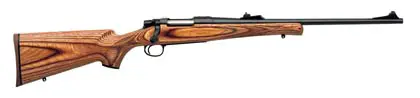
The CDL comes in 13 calibers ranging from .17 Fireball to .350 Rem. Mag., but the cartridges of choice for the deer hunter are .243 Win., 7mm-08 and .308 Win. These provide good killing power with big game hunting weight bullets and tolerable recoil. In the latter area the .243 is superior to the 7mm-08 and .308 Win. See the Product Review Page for more about the Model Seven.
- Ruger International Model 77RSI -
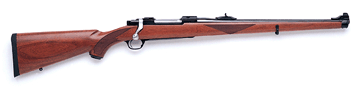
- Ruger No. 1A and K1A -

Medium to long range rifles (open country deer rifles)
- Browning A-Bolt II Medallion -
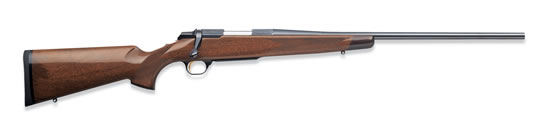
There are a number of variations in the A-Bolt line beside the Medallion. These include the well known Hunter (walnut stock, satin finish) and Stainless Stalker (black composite stock and stainless steel barreled action).
Medallion rifles come in a wide variety of standard and magnum calibers from .223 Rem. to .375 H&H Mag. Appropriate long range deer calibers include the .243 Winchester, .25-06, .270 Win. and .280 Rem. Reviews of the Browning A-Bolt II line can be found on the Product Review Page.
- Remington Model 700 BDL, CDL, Mountain Rifle LSS -
Renown for its strength, accuracy and handsome appearance, the Model 700 BDL features a gloss finish walnut stock with ample checkering and a black forearm tip, polished blue metal surfaces, an adjustable trigger, and many other nice touches. The CDL is similar but its metal and wood finish is matte. The BDL and CDL weigh 7 3/8 pounds in standard long action calibers and measure 42 1/2" long. The LSS Mountain Rifle features a stainless steel barreled action and a brown laminated hardwood stock. It comes with a light contour 22" barrel, is 42-1/2" long and weighs 6-5/8 pounds.

- Ruger No. 1B -

- Weatherby Mark V Accumark -

The Accumark is available in 7 standard and magnum calibers. (Other calibers are available through the Weatherby Custom Shop.) The Weatherby Mark V line is reviewed in detail on the Product Review Page.
- Weatherby Mark V Deluxe -
In the case of a Weatherby Mark V Deluxe you get a great deal. One look at the highly polished, deep luster blued barreled action, Monte Carlo claro walnut stock with its fineline checkering pattern, maple grip cap inlay and line spacers, and contrasting forearm tip make it is clear that the Mark V Deluxe is a top of the line hunting rifle.

The Deluxe weighs 6.75 pounds in standard calibers and 8.5 pounds in most magnum calibers. Overall length is 44" with the 24" barrel supplied with standard calibers, and 46 5/8" with the 26" barrel supplied on magnum caliber rifles.
The Mark V Deluxe is available in some 17 standard and magnum calibers, from .22-250 to .460 Weatherby Magnum. Included are traditional long range favorites like .243 Winchester, .25-06, .270 Winchester, and .280 Remington. Also available are ultra-long range calibers such as the .240, .257, and .270 Weatherby Magnums that will drop deer cleanly at ranges well beyond where most hunters are capable of making sure hits. Roy Weatherby's favorite ultra-long range deer cartridge, and mine, is the .257 Weatherby Magnum. The Weatherby Mark V line is reviewed in detail on the Product Review Page.
- Weatherby Vanguard SUB-MOA Stainless -
SUB-MOA barreled actions are selected from among all Vanguards after accuracy testing is completed then are then dropped into their special stocks. As the name implies, these select Vanguards are guaranteed to deliver three shot groups at 100 yards measuring less than 1" with premium factory loaded ammunition. Weight is 7.75 pounds in standard calibers and overall length is 44.5".

10 Great Places to Hunt Waterfowl
1. Southern Saskatchewan
By virtually any measure, Saskatchewan would rank high among North America’s best places to hunt waterfowl. The province is not only the continent’s most important breeding area for mallards, pintails, and other dabbling ducks but also a staging hub for Arctic geese and other waterfowl raised across the Far North. In certain areas of this province’s vast prairie-parkland region, it’s not uncommon to take large and small subspecies of Canada geese, white-fronted geese, light geese, mallards, and pintails in the same decoy spread. Public hunting is available on many large wetland projects conserved by Ducks Unlimited and its partners in the North American Waterfowl Management Plan. Freelance waterfowlers can also secure permission from farmers to hunt on private land.When it’s hot: late September-October
Abundant species: mallards, pintails, canvasbacks, redheads, Canada geese, white-fronted geese, light geese
Contact: Tourism Saskatchewan sasktourism.com
2. Eastern North Dakota
Whether you are pursuing Canada geese, light geese, dabbling ducks, or divers, you can find them in abundance somewhere in North Dakota. Located in the heart of the prairie Duck Factory, this state supported more than 8 million breeding ducks in 2009 and hosts even larger numbers of staging waterfowl during the fall migration. Hunting access is available on a variety of public lands in the eastern half of the state, including federal waterfowl production areas, state wildlife management areas, and properties enrolled in the state’s Private Lands Open To Sportsmen (PLOTS) program.When it’s hot: October-early November
Abundant species: mallards, pintails, gadwalls, green-winged teal, lesser scaup, Canada geese, lesser snow geese
Contact: North Dakota Game and Fish Department gf.nd.gov
3. Central Valley of California
Acre for acre, the Central Valley of California supports more wintering waterfowl than anywhere else in North America. At peak times, this region hosts 5 to 7 million wintering waterfowl—more than 60 percent of the Pacific Flyway’s ducks and geese. As you would expect, the high ratio of birds to habitat results in some superb waterfowl hunting. This is especially true on private duck clubs in places such as Butte Sink, Suisun Marsh, and the Grasslands. Good public hunting is also available on several intensively managed national wildlife refuges and state wildlife areas in the region, which also support large numbers of wintering waterfowl.When it’s hot: late November-January
Abundant species: pintails, mallards, wigeon, green-winged teal, Aleutian cackling geese,
white-fronted geese, light geese
Contact: California Department of Fish and Game dfg.ca.gov
4. South Louisiana
Any survey of North America’s top waterfowl hunting areas would have to include Louisiana. America’s Wetland—as south Louisiana’s coastal marshes are collectively known—supports upwards of 9 million migrating and wintering ducks on average. Some of the state’s best duck hunting can be found on the Chenier Plain in southwest Louisiana. Freelancers equipped with shallow-running duck boats will find plenty of public hunting opportunities on the massive Sabine and Lacassine national wildlife refuges in Cameron Parish.When it’s hot: late November-January
Abundant species: gadwalls, green-winged teal, blue-winged teal, pintails, mottled ducks, white-fronted geese, lesser snow geese
5. Peace River Country, Alberta
As the northernmost major grain-producing region in North America, the Peace River Country of northwestern Alberta is a magnet for migrating waterfowl raised across the boreal forest and Arctic. In September, waves of Canada geese, white-fronted geese, lesser snows, Ross’s geese, mallards, pintails, and other dabbling ducks descend on the region to gorge themselves on wheat, barley, lentils, and peas. As in other parts of Prairie Canada, visiting hunters can freelance by scouting the fields and asking permission from local landowners.When it’s hot: September-early October
Abundant species: mallards, pintails, wigeon, green-winged teal, Canada geese, white-fronted geese, light geese
Contact: Travel Alberta mywildalberta.com
6. Texas Panhandle
The Texas Panhandle lies in the heart of what is known as the playa lakes region, also encompassing parts of New Mexico, Colorado, Oklahoma, Kansas, and Nebraska. Much like the prairie potholes of the northern Great Plains, playas are dependent on seasonal precipitation, and in those special years when timely rainfall replenishes these unique wetlands, the Panhandle fills up with incredible numbers of waterfowl. Hunting pressure is light across much of this sparsely populated region. Freelance waterfowlers can often receive permission from landowners to hunt waterfowl on playas and private agricultural land.When it’s hot: late November-December
Abundant species: mallards, pintails, wigeon, green-winged teal, Canada geese
Contact: Texas Parks and Wildlife Department tpwd.state.tx.us
7. Eastern Arkansas
Known as the Duck Capital of the World, Stuttgart, Arkansas, has long been a favorite destination for waterfowl hunters from near and far—and for good reason. Extensive rice production, naturally flooded bottomland hardwoods, and intensively managed green-tree reservoirs make the broad alluvial plain surrounding Stuttgart a winter paradise for mallards—and duck hunters. For those willing to work for their birds, good public hunting is available on the nearly 34,000-acre Bayou Meto Wildlife Management Area in Jefferson and Arkansas counties and the 160,000-acre White River National Wildlife Refuge, spanning nearly 90 miles in four counties.When it’s hot: late November-January
Abundant species: mallards, pintails, wood ducks, green-winged teal, gadwalls, white-fronted geese, lesser snow geese
Contact: Arkansas Game and Fish Commission agfc.com
8. Great Salt Lake, Utah
The Great Salt Lake is an oasis for breeding and migrating waterfowl in the heart of the arid Great Basin. This 70-mile-long lake and associated marshes are among the continent’s most important staging areas for pintails and other dabbling ducks. Steeped in waterfowling tradition, Great Salt Lake is home to nearly 30 private hunting clubs, such as the Bear River Club—dating back to 1901—as well as the Chesapeake, North Point, Harrison, Rudy, Ambassador, and New State clubs. Public hunting is available on the lake itself and on several state waterfowl management areas along its shores.When it’s hot: early October-November
Abundant species: pintails, mallards, wigeon, gadwalls, shovelers, green-winged and cinnamon teal
Contact: Utah Division of Wildlife Resources wildlife.utah.gov
9. Upper Mississippi River
During the 1930s, the U.S. Army Corps of Engineers built a series of locks and dams on the upper Mississippi River, creating a vast network of shallow open water, islands, and marsh along the borders of Minnesota, Iowa, and Wisconsin. Not surprisingly, these wetlands attract droves of staging waterfowl during migration. At peak times, more than 50 percent of the continent’s canvasbacks as well as thousands of other ducks, geese, and swans gather on the Upper Mississippi River National Wildlife and Fish Refuge. Public hunting is allowed throughout much of this sprawling 240,000-acre area, and waterfowlers equipped for hunting big water have good success gunning from points and islands along the shoreline.When it’s hot: late October-November
Abundant species: canvasbacks, redheads, lesser scaup, mallards, Canada geese
10. Chesapeake Bay
The cradle of American waterfowling, Chesapeake Bay has a rich sporting heritage dating back to Captain John Smith, who first hunted in the region during the early 1600s. More than 400 years later, the region remains a good place to hunt a variety of waterfowl. The nation’s largest estuary is among the Atlantic Flyway’s most important migration and wintering areas for dabblers and divers. In addition, nearly the entire population of Atlantic Canada geese winters along Maryland’s Eastern Shore and surrounding areas. Public waterfowl hunting opportunities abound on the bay itself as well as on wildlife management areas and national wildlife refuges.When it’s hot: December-January
Abundant species: mallards, black ducks, green-winged teal, canvasbacks, Canada geese, greater snow geese
Subscribe to:
Posts (Atom)